How To Calculate Indirect Bilirubin . Find the total bilirubin on your laboratory report. Indirect (unconjugated) bilirubin will not be measured, this will calculate. Bilirubin Part 1 Total, Direct and Indirect Bilirubin, Classification from www.labpedia.net • synthesizing power of liver will be diminished and hence low Portland, maine country club membership fees woman's world horoscope for this week The total bilirubin is measured in the serum and represents the amount of unconjugated or indirect and conjugated or direct bilirubin.
How To Calculate Power Dissipated By A Resistor. The equation of power is p = v x i. Resistors plays a major role in reducing the current in circuits and therefore protecting circuits from damage resulting from overdraw of current by dissipating the kinetic energy of electrons in current as thermal energy (heat).
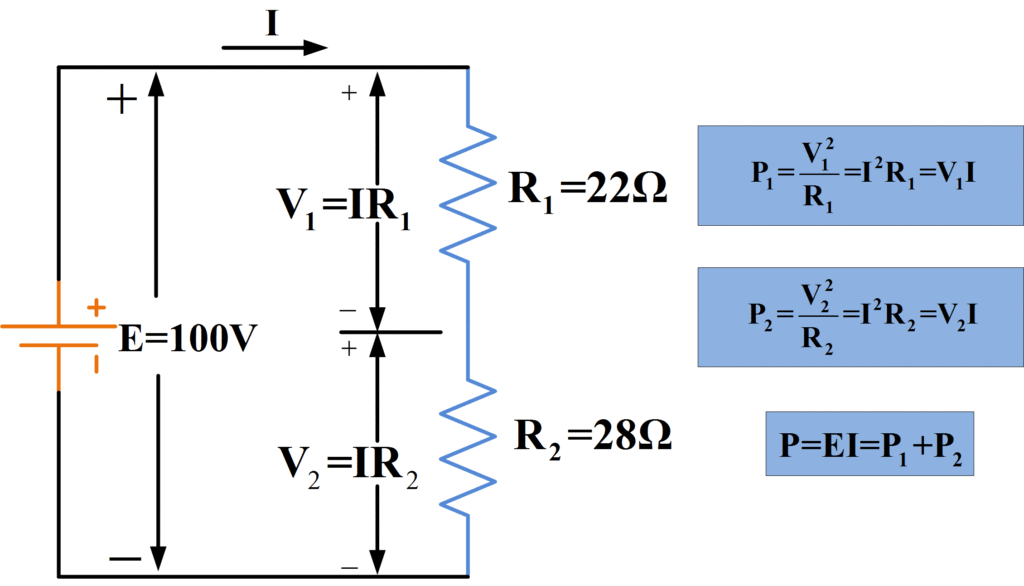
Series Circuit Definition Series Circuit Examples Electrical Academia from electricalacademia.com
Resistors plays a major role in reducing the current in circuits and therefore protecting circuits from damage resulting from overdraw of current by dissipating the kinetic energy of electrons in current as thermal energy (heat). With 330pf, 16v and 2.1mhz, this results in about 180mw being dissipated in the resistor. 24 v/12 ω = 2 a.
An Ideal Zero Ohm Resistor Would Have Zero Power Dissipated In It For Any Finite Current Through It, On The Other Hand It Would Have Infinite Power Dissipated For Any Finite Voltage Across It.
With 330pf, 16v and 2.1mhz, this results in about 180mw being dissipated in the resistor. Say if the current flowing through it is i amps. 4 + 2 + 6 = 12 ω.
The Resistors Are In Parallel So They Will Both Have The Same.
The formula p = i v also gives the power generated by a battery if i is the current coming from the. You can enter values with si suffixes like 12.2m (equivalent to 0.012) or 14k (14000) or 32u (0.000032). Calculating the power dissipated by a resistor in the field of electronics, power dissipation is also a measurement parameter that quantifies the releasing of heat.
This Is What Allows Electricity To Be Useful:
Where i is the current through the resistor and v is the voltage drop across it. Resistors plays a major role in reducing the current in circuits and therefore protecting circuits from damage resulting from overdraw of current by dissipating the kinetic energy of electrons in current as thermal energy (heat). This electronics video tutorial explains how to calculate the power dissipation in resistors, diodes, and leds or light emitting diodes.
For Every Switching Cycle, The Snubber Capacitor Has To Be Charged And Discharged Once, Which Will Dissipate The Same Amount Of Energy In The Resistor.
Transistor q2 for outa1 is determined by the resistor divider formed between the collector emitter the attenuation will be for a given transistor. P = i 2 r [ since v = ir] v is the voltage. We can now calculate the power dissipated by each using p = i2r.
The Electrical Power Gets Converted To Heat Energy, And Therefore All The Resistors Will Have A Power Rating.
P = i × v. If the total power dissipated is the sum of each resistor's power dissipation, then 28.2 = (i1^2)(r1) + (i2^2)(r2). Once you have found the necessary current, then you can use that relationship to calculate the power dissipated in the individual resistor(s).


Comments
Post a Comment